Author: Mohit Jha

  • How to Create a Webinar Presentation (Step-by-Step Guide)

    Webinars have become one of the most effective ways for businesses, educators, marketers, and professionals to connect with audiences online. Whether you’re launching a product, training employees, educating customers, or generating leads, a well-designed webinar presentation can make the difference between an engaged audience and one that loses interest after a few minutes.

    However, creating an effective webinar presentation isn’t just about adding information to PowerPoint slides. It requires clear objectives, a logical flow, engaging visuals, and content that keeps your audience focused from start to finish. The good news is that modern AI tools can help simplify much of this process, allowing you to spend more time refining your message instead of designing every slide manually.

    Quick Answer:

    In this guide, you’ll learn how to create a webinar presentation step by step, discover best practices for designing engaging slides, and see how AI can help you build professional presentations in minutes.

    Creating a webinar presentation involves defining your objective, understanding your audience, organising your content into a clear outline, designing visually engaging slides, adding interactive elements, and rehearsing before going live. AI presentation tools can further simplify the process by generating structured, editable presentations in minutes.

    What Is a Webinar Presentation?

    A webinar presentation is a structured slide deck used to deliver information during an online seminar or virtual event. Unlike a traditional in-person presentation, webinar slides are designed for digital audiences viewing through platforms such as Zoom, Microsoft Teams, Google Meet, or Cisco Webex.

    A typical webinar presentation includes an agenda, key discussion points, visuals, examples, and a clear call to action. Depending on the purpose, webinar presentations can be used for:

    • Product demonstrations
    • Customer onboarding
    • Employee training
    • Educational sessions
    • Sales presentations
    • Marketing webinars
    • Internal meetings
    • Thought leadership events

    The goal is to communicate information clearly while keeping attendees engaged throughout the session.

    Why a Great Webinar Presentation Matters?

    A well-planned webinar presentation does more than support your speech it helps your audience understand, remember, and act on the information you’re sharing.

    Some of the biggest benefits include:

    • Higher audience engagement: Well-designed slides with visuals, examples, and interactive elements keep attendees interested throughout the webinar.
    • Better knowledge retention: Clear, structured slides make complex topics easier to understand and remember.
    • Professional brand image: Consistent colours, fonts, and layouts create a polished presentation that reflects your brand professionally.
    • Improved conversions: Whether your goal is generating leads, selling a product, or educating customers, a strong presentation helps communicate your message more effectively.

    How to Create a Webinar Presentation?

    Step 1: Define Your Goal and Audience

    Before creating your first slide, determine exactly what you want your webinar to achieve.

    Ask yourself:

    • Who is my audience?
    • What problem am I helping them solve?
    • What should attendees learn?
    • What action should they take after the webinar?

    For example, a customer onboarding webinar will focus on product education, while a sales webinar may highlight features, benefits, and customer success stories. Defining your objective early helps you build a presentation that stays focused from beginning to end.

    Step 2: Create a Clear Presentation Outline

    A webinar presentation should follow a logical structure so attendees can easily follow the discussion.

    A simple outline includes:

    • Title slide
    • Agenda
    • Introduction
    • Problem or challenge
    • Solution
    • Main discussion
    • Examples or demonstrations
    • Key takeaways
    • Q&A
    • Call to action

    Planning your presentation before designing slides reduces unnecessary edits later and creates a smoother flow.

    Step 3: Design Clean and Engaging Slides

    Good webinar slides support your presentation they shouldn’t replace it.

    Keep these best practices in mind:

    • Use one idea per slide.
    • Keep text concise.
    • Use readable fonts and consistent colours.
    • Include charts, icons, screenshots, or diagrams where appropriate.
    • Leave enough white space to improve readability.
    • Maintain consistent branding throughout the presentation.

    Instead of filling slides with paragraphs, use visuals and concise bullet points to reinforce your message while you explain the details.

    Step 4: Add Interactive Elements

    One of the biggest advantages of webinars is real-time interaction.

    Keep your audience engaged by including:

    • Live polls
    • Q&A sessions
    • Audience questions
    • Short quizzes
    • Product demonstrations
    • Interactive discussions

    These elements encourage participation and help attendees stay focused throughout the presentation.

    Step 5: Rehearse and Deliver with Confidence

    Even the best-designed presentation can lose impact without proper preparation.

    Before your webinar:

    • Practice your timing.
    • Test your microphone and camera.
    • Check screen sharing.
    • Review speaker notes.
    • Confirm your internet connection.
    • Prepare answers for common questions.

    If you’re using AI Presentations, you can generate a structured presentation in minutes, customise every slide, and export it to Microsoft PowerPoint or Google Slides before your webinar begins.
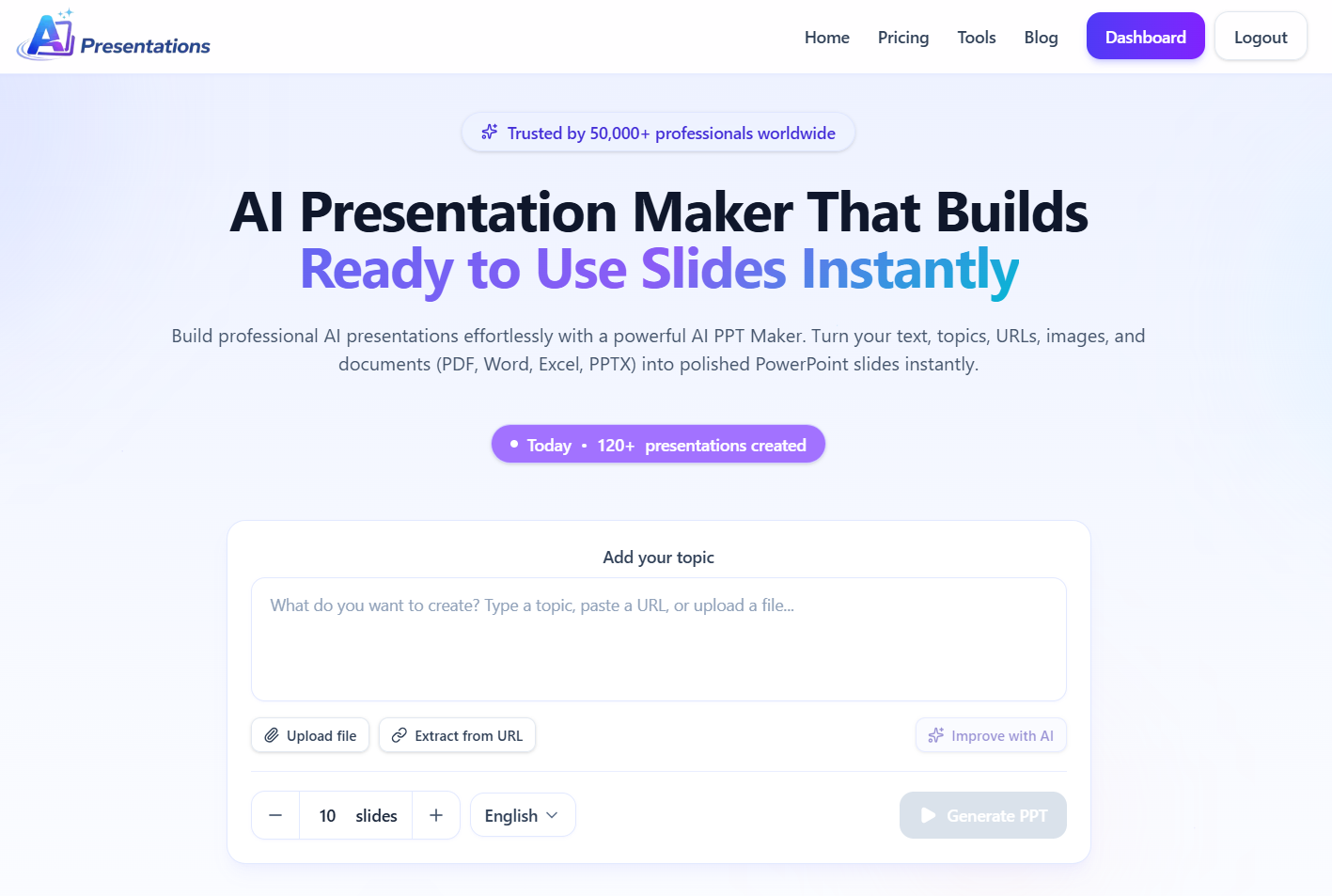
    AI creating webinar presentation slides

    Example Webinar Presentation Structure

    Most successful webinar presentations follow a simple flow:

    • Welcome & Title
    • Agenda
    • Introduction
    • Problem Statement
    • Solution
    • Key Features or Main Content
    • Examples or Case Study
    • Summary
    • Questions & Answers
    • Call to Action

    For example, imagine you’re hosting a 30-minute webinar to introduce a new software feature. Your presentation might begin with the problem customers face, demonstrate the new feature, highlight its benefits with real examples, answer audience questions, and conclude with the next steps or product trial invitation.

    Common Webinar Presentation Mistakes to Avoid

    Even experienced presenters can make mistakes that reduce audience engagement.

    • Adding too much text: Slides should highlight key points, not display your entire script.
    • Poor presentation structure: Jumping between unrelated topics makes it difficult for attendees to follow your message.
    • Weak visuals: Charts, screenshots, diagrams, and icons often communicate ideas better than paragraphs of text.
    • Ignoring audience interaction: Webinars perform better when attendees can participate through polls, questions, or discussions.
    • Skipping rehearsal: Always review your presentation before going live to ensure smooth delivery and avoid technical issues.

    Use AI to Create Stunning Webinar Presentations in Minutes

    Creating a webinar presentation doesn’t have to take hours. AI Presentations helps you generate a well-structured, professional slide deck in minutes, complete with clear content, polished layouts, and editable slides. You can customise the presentation to match your brand and export it to Microsoft PowerPoint or Google Slides, making it easy to prepare for your next webinar with less effort and more confidence.
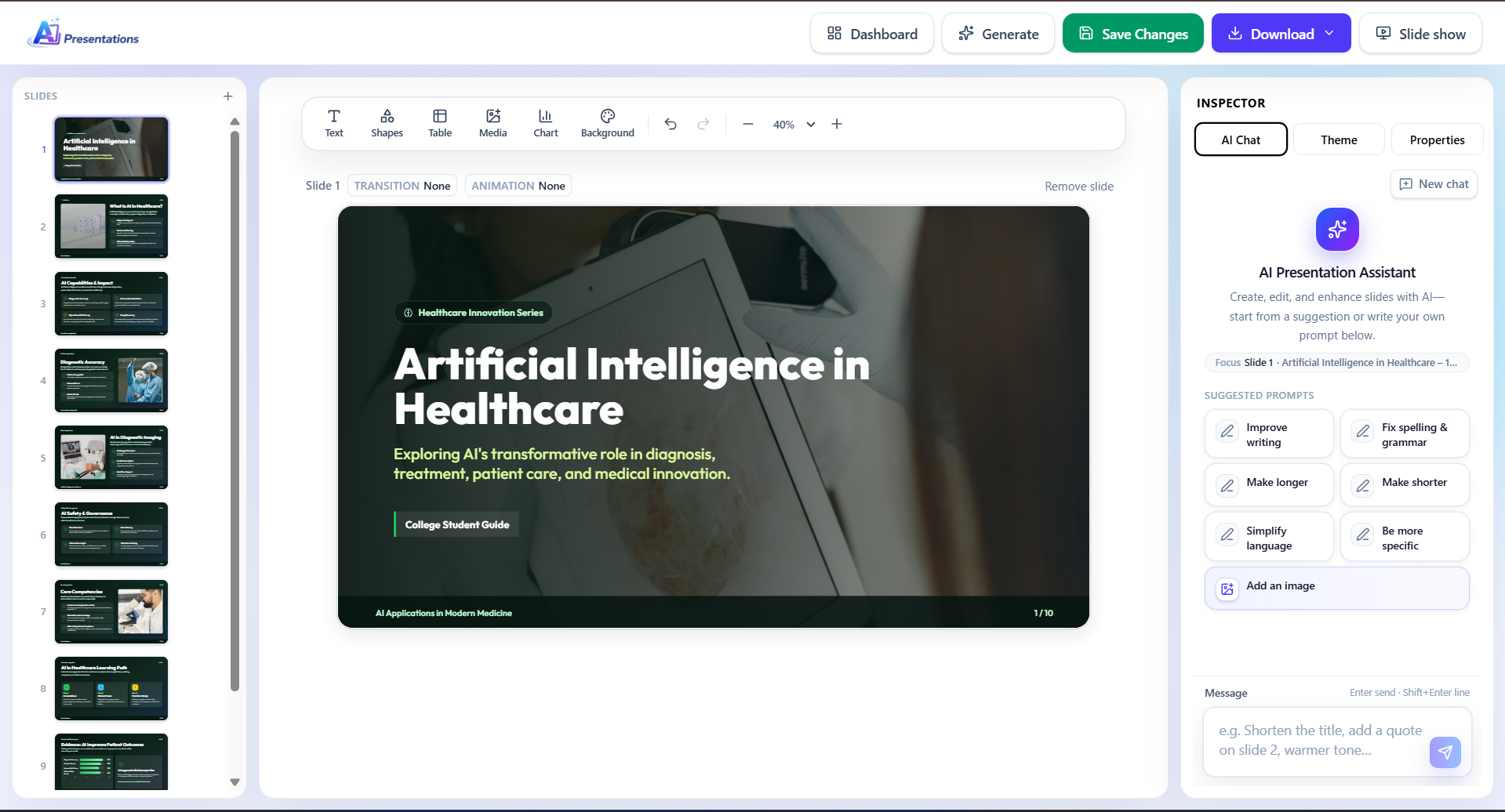
    Professional webinar presentation example

    Frequently Asked Questions

    Q1. Can AI create a webinar presentation?

    Yes. AI PPT tools can generate presentation outlines, organise content into slides, suggest layouts, and produce editable PowerPoint or Google Slides presentations within minutes.

    Q2. How many slides should a webinar presentation have?

    It depends on the webinar length. A 30-minute webinar typically includes around 15–20 slides, while a 60-minute webinar may require 25–35 slides.

    Q3. Should I use PowerPoint or Google Slides?

    Both are excellent choices. Microsoft PowerPoint offers advanced presentation features, while Google Slides is ideal for collaboration and cloud-based editing.

    Q4. What should a webinar presentation include?

    A webinar presentation should include a title slide, agenda, introduction, main discussion points, visuals, examples, key takeaways, a Q&A section, and a clear call to action.

    Q5. Can I customise AI-generated presentations?

    Absolutely. AI-generated presentations are fully editable, allowing you to update text, change layouts, apply branding, and export the presentation before sharing it.

    Q6. How can I make my webinar more engaging?

    Use concise slides, visuals, audience polls, live Q&A sessions, real-world examples, and interactive discussions to keep attendees involved throughout the webinar.

    Also read: Convert Webinar to PowerPoint: A Step-by-Step Guide

    Final Thoughts

    Instead of spending hours planning, writing, and designing every slide manually, AI Presentations helps you create professional webinar presentations in minutes. Generate a structured slide deck, customise it to match your brand, and present with confidence using Microsoft PowerPoint or Google Slides. Whether you’re hosting a product demo, training session, sales webinar, or educational event, you’ll spend less time building slides and more time engaging your audience.

  • Webinar to PPT: Convert Webinar Content into Professional Slides with AI

    Webinars have become one of the most effective ways to educate customers, train employees, demonstrate products, and share expertise. However, once the live session ends, valuable insights often remain locked inside a lengthy webinar recording or transcript. Manually turning that information into a presentation can take hours of reviewing, summarising, designing, and formatting.

    That’s where AI changes the workflow.

    Instead of rebuilding your presentation from scratch, modern AI tools can analyse webinar content, identify the most important topics, organise ideas into logical sections, and generate presentation-ready slides in minutes. Whether you’re repurposing a customer webinar, an internal training session, or a product demonstration, AI helps transform your content into polished PowerPoint or Google Slides presentations with minimal effort.

    In this guide, you’ll learn what a webinar-to-PPT workflow looks like, why businesses are adopting it, and how AI can dramatically reduce the time required to create professional presentation decks.

    What Does Webinar to PPT Mean?

    A Webinar to PPT workflow refers to converting the content of a webinar into a structured presentation that can be edited, shared, or presented later.

    Rather than replaying an entire webinar whenever someone needs the information, organisations often convert key ideas into presentation slides that are easier to consume and distribute.

    These presentations can be used for:

    • Employee onboarding
    • Customer education
    • Sales enablement
    • Product demonstrations
    • Partner training
    • Executive summaries
    • Knowledge sharing
    • Workshop materials

    Instead of reviewing a one-hour webinar multiple times, you can present the same information in a concise 15-slide deck.

    Why Businesses Convert Webinars into Presentations?

    A webinar usually contains far more information than an audience can retain in a single session. Converting it into presentation slides makes that knowledge reusable across different teams and use cases.

    • Improve Knowledge Sharing: Presentation decks are easier to circulate across departments than long webinar recordings. Employees can quickly review key concepts without watching an hour-long session.
    • Support Sales Teams: Product webinars often contain valuable demonstrations and customer insights. Turning them into presentation slides helps sales representatives communicate the same value consistently.
    • Simplify Training: Training webinars can become reusable learning materials for future employees, reducing the need to repeat live sessions.
    • Create Executive Summaries: Leadership teams rarely have time to watch full webinars. A concise slide deck highlighting objectives, key findings, and recommendations communicates information much faster.
    • Repurpose Existing Content: One webinar can become multiple assets, including presentation decks, documentation, blog posts, and training materials, helping organisations maximise the value of their content.

    Types of Webinars You Can Convert into PowerPoint

    Not every webinar has the same objective, but almost any webinar can be transformed into a professional presentation with AI. Whether you’re educating customers or training employees, converting webinar content into slides makes it easier to share information, improve engagement, and reuse valuable content.

    You can convert various types of webinars into PowerPoint presentations, including:

    • Product demonstration webinars
    • Customer onboarding webinars
    • Employee training sessions
    • Sales enablement webinars
    • Marketing webinars
    • Educational webinars
    • Partner enablement webinars
    • Industry thought leadership webinars
    • Product launch webinars
    • Internal company webinars

    Each webinar type benefits from a slightly different presentation structure, but the goal remains the same present key insights in a clear, visual, and easy-to-understand format.

    How AI Converts a Webinar into a Presentation?

    Artificial Intelligence combines Natural Language Processing (NLP) and Large Language Models (LLMs) to analyse webinar content, identify the most important discussion points, summarise key ideas, and organise them into a logical presentation structure.

    Instead of copying every sentence from a webinar, AI focuses on the information that belongs on presentation slides, helping you create concise, visually engaging presentations in a fraction of the time it would take manually.

    A typical AI-powered workflow includes the following steps.

    Step 1: Upload Your Webinar Content

    Upload your webinar content to an AI presentation tool. The AI analyses the webinar, understands the discussion, and prepares the key information for presentation generation.

    webinar-topic-cover

    The AI analyses the content while preserving the overall structure and context.

    Step 2: Identify Key Topics

    Large Language Models (LLMs) and Natural Language Processing (NLP) identify:

    • Main discussion topics
    • Important insights
    • Action items
    • Key takeaways
    • Supporting examples

    Instead of copying every sentence, AI focuses on the information that belongs on presentation slides.

    Step 3: Organise Information into Sections

    Good presentations follow a logical flow.

    AI automatically groups related information into sections such as:

    • Introduction
    • Agenda
    • Challenges
    • Solutions
    • Results
    • Recommendations
    • Next Steps

    This makes the final presentation easier to understand.

    Step 4: Generate Presentation Slides

    Each section becomes one or more slides with:

    • Clear headings
    • Concise bullet points
    • Logical content hierarchy
    • Professional layouts
    • Consistent formatting

    Rather than overwhelming the audience with text, AI produces presentation-friendly content.

    Step 5: Refine and Export

    After reviewing the generated slides, you can make edits, adjust the design, and export the presentation to PowerPoint or Google Slides for collaboration and delivery.

    Example: Converting a Webinar into a Presentation

    Imagine you’ve just finished hosting a 45-minute product webinar introducing a new software feature. Instead of replaying the webinar and manually creating slides, AI analyses the discussion, identifies the agenda, product highlights, customer benefits, and next steps, then organises everything into a professional presentation. After a quick review, you can customise the design and export it as a PowerPoint or Google Slides presentation in just a few minutes.

    Also read: How to Add Video to Google Slides?

    AI vs Manual Webinar-to-PPT Comparison

    While creating slides manually gives you complete control, it also requires significant time and effort. AI automates much of the repetitive work, allowing you to focus on refining your message rather than building every slide from scratch. Here’s how the two approaches compare:

    Feature AI Webinar-to-PPT Manual Presentation Creation
    Time Required Minutes Several hours
    Summarises Key Insights ✅ Automatically ❌ Manual note-taking
    Creates Slide Structure ✅ Yes ❌ Build from scratch
    Generates Professional Layouts ✅ Automatically ❌ Manual design
    Maintains Consistent Formatting ✅ Yes Depends on the creator
    Editable After Generation ✅ Fully editable ✅ Yes
    Export to PowerPoint & Google Slides ✅ One-click export Manual formatting required
    Best For Fast, scalable presentation creation One-off presentations

    Ready to turn your webinar into a professional presentation?

    With AI Presentations, you can generate editable PowerPoint or Google Slides presentations from your webinar content in minutes. Instead of spending hours organising information and designing slides, let AI create a structured presentation that you can customise and share immediately.

    Common Mistakes to Avoid

    • Copying the Webinar Word for Word: Presentation slides should summarise ideas rather than reproduce an entire webinar transcript.
    • Adding Too Much Text: Crowded slides reduce audience attention. Keep information concise and presentation-friendly.
    • Ignoring Structure: Randomly arranged slides make presentations difficult to follow. Maintain a logical progression throughout the deck.
    • Inconsistent Formatting: Different fonts, colours, and layouts can make presentations appear unprofessional. Use a consistent design throughout.
    • Skipping the Final Review: AI accelerates slide creation, but reviewing the presentation ensures accuracy and clarity before sharing it.

    Why Choose AI Presentations to Convert a Webinar into PPT?

    Creating a PowerPoint from a webinar manually takes time. AI Presentations makes it easy by turning your webinar content into a well-structured, editable presentation in minutes.

    webinar-topic-cover

    With AI Presentations Tool, you can:

    • Convert webinar content into PowerPoint or Google Slides
    • Automatically generate clear slide titles and key takeaways
    • Create professional, presentation-ready slides instantly
    • Customise themes, layouts, and branding
    • Edit and export your presentation with ease

    Whether you’re creating training materials, sales presentations, or customer education decks, AI Presentations helps you save time while delivering polished, professional presentations.

    Turn your next webinar into an engaging PowerPoint in minutes with AI Presentations App.

    Frequently Asked Questions

    Q1. Can AI convert webinar content into PowerPoint?

    Yes. AI can analyse webinar content, identify important topics, organise information into slides, and generate presentation-ready PowerPoint decks that can be edited further.

    Q2. Can I create Google Slides from webinar content?

    Yes. Many AI presentation tools allow you to generate presentations that can be exported to Google Slides for collaboration and sharing.

    Q3. Is AI-generated presentation content editable?

    Absolutely. You can modify slide text, layouts, images, colours, and themes after generation.

    Q4. How long does it take to convert webinar content into slides?

    Depending on the length and complexity of the webinar, AI can usually generate a presentation within minutes, significantly faster than manual creation.

    Q5. Can AI summarise webinar content before creating slides?

    Yes. Modern AI uses Natural Language Processing (NLP) to identify key themes, remove repetitive information, and organise ideas into a structured presentation.

    Q6. What’s the difference between a webinar recording and a webinar presentation?

    A webinar recording captures the complete session, while a webinar presentation highlights the essential points in a concise, visual format that is easier to present, review, and share.

    Q7. Can I customise AI-generated webinar presentations?

    Yes. You can edit slide content, rearrange sections, update themes, apply your own branding, and export the presentation as PowerPoint or Google Slides before sharing it with your audience.

    Final Thoughts

    Webinars contain valuable knowledge, but long sessions are rarely the most efficient way to share information. Converting webinar content into a well-structured presentation helps teams communicate ideas faster, improve knowledge retention, and reuse existing content across multiple business functions.

    By combining AI with modern presentation workflows, you can transform webinar insights into polished PowerPoint or Google Slides presentations in a fraction of the time it would take manually. Whether you’re supporting employee training, customer education, sales enablement, or executive reporting, AI-powered presentation generation allows you to focus less on formatting and more on delivering impactful ideas.

    Instead of letting valuable webinar insights remain inside a recording, repurpose them into engaging PowerPoint or Google Slides presentations that are easier to share, present, and reuse across your organisation. With AI Presentations, you can create professional webinar presentations in minutes while saving hours of manual work.

    Also read: How to Transfer PowerPoint to Google Slides?